Is Albufeira Safe? What Actually Goes Wrong

Is Albufeira safe? Yes, for the overwhelming majority of visitors: violent crime is low, and the real risks here are pickpocketing in crowds, bag-snatching, and opportunist theft from unlocked holiday properties in the tourist areas, not anything more serious. It genuinely isn't risk-free, and the town's reputation, built mostly on one small nightlife district, deserves an honest look rather than a blanket verdict. Below, as of July 2026, is the full picture: petty crime, the beach flag system, the rules that carry real fines, solo and solo female travel, and the heat, cliffs and water hazards worth knowing about. If you're travelling with children, our family-friendly things to do in Albufeira all fit around this safety picture.
Quick answer
Albufeira is safe for the vast majority of visitors: violent crime is low, and the real risks are pickpocketing, bag-snatching, and theft from unlocked properties rather than anything more serious. It isn't risk-free, and the town's rowdy reputation belongs mostly to one small nightlife district, not the whole place.
Key takeaways
- Violent crime is low; petty theft in crowds and from holiday properties is the real, avoidable risk
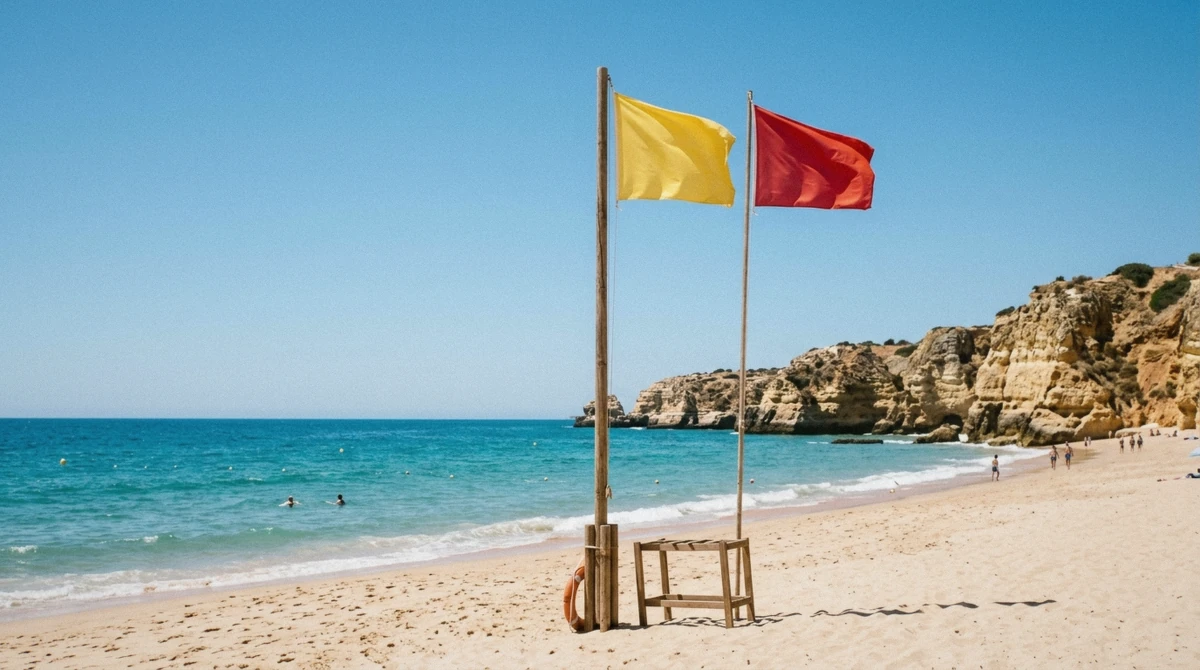
- Portugal's beach flag system runs green, yellow, red, chequered and blue-and-purple for dangerous marine life; swim only inside the paired yellow-and-red lifeguarded zone
- Street swimwear, bare chests and public drinking carry fines from €300 to €1,500, up to €1,800 for full nudity, though the beach and pools themselves are unaffected
- The Old Town and the party-focused strip sit 3.2 km apart, so the rowdy reputation belongs to one district, not the whole town
- Heat and dehydration are a bigger everyday risk than crime in July and August, when highs reach 29.1°C
The Honest Picture
Albufeira does have a reputation, mostly earned by Areias de São João, the strip, an 800-metre run of bars and clubs above Praia da Oura that runs loud from 11pm to 6am and pulls a young, often British and Irish, stag-and-hen crowd in peak summer. Does Albufeira have a bad reputation? In that one district, yes, deservedly. Is Albufeira just a party town? No, not as a whole; the Old Town, 3.2 km away, is a genuinely different experience, whitewashed lanes, a pedestrianised square, café terraces and a fishing beach below.
Is the Old Town itself rowdy? Less than the strip, but it isn't silent either; the square and its bars stay lively until midnight before winding down, which suits most visitors fine but isn't what someone picturing total quiet has in mind. Choosing where to stay, more than choosing whether to visit Albufeira at all, is what actually determines how much of the party reputation you experience.
Most of what gets reported as trouble in Albufeira traces back to alcohol, not targeted crime against visitors: a rowdy group on the strip at 4am, an argument outside a club, a stumble on uneven paving. It's rarely something aimed at a tourist walking through in daylight. The families booking the jeep safari or the surf lesson at Galé and the groups filling the strip's clubs are, in practice, moving through two different Albufeiras that happen to share a postcode.
Petty Crime and How It Happens
Violent crime against tourists is low. The real risks are mundane: pickpocketing in crowds, especially around the Old Town square at night and any queue near the strip, bag-snatching from unattended bags at the beach or a café table, and theft from holiday apartments and hotel rooms left unlocked or with a balcony door open.
Practical steps cover nearly all of it: use the room safe, don't leave valuables visible in a parked rental car, keep bags zipped and on your lap rather than hanging off a chair back, and treat a crowded night out on the strip the same way you'd treat any crowded nightlife district anywhere, phone in a front pocket, drinks watched, and a plan for getting back to your accommodation before you've had too many.
A rental apartment near the strip is a slightly higher-risk booking than a hotel with staffed reception, simply because there's nobody watching the corridor; check that ground-floor windows and any balcony door actually lock before you unpack. If something is taken, report it at the nearest police station for a written statement, most travel insurance policies require one before they'll process a claim, and keep the reference number with your other trip documents rather than only on a phone that might be the thing that was taken.
What Actually Goes Wrong, and How Often
The risk register, in order of likelihood
Almost nothing on this list is violent. The things that spoil trips here are opportunistic theft, the sea, the heat and, increasingly, a fine for something you did not know was an offence.
| What goes wrong | How likely | Where it happens | What prevents it |
|---|---|---|---|
| Pickpocketing and bag-snatching | The most common problem | Crowded beaches, markets, busy bars | Front pockets, a zipped bag, nothing left on a sunbed |
| Theft from holiday properties | Common enough to plan for | Ground-floor apartments and villas | Lock the balcony door, use the safe |
| A fine under the code of conduct | Easy to trigger without knowing | Streets between the beach and the hotel | Cover up before leaving the sand |
| Getting into trouble in the water | Occasional, and serious | Unpatrolled stretches, red-flag days | Swim between the paired yellow and red flags |
| Heat and dehydration | Routine in July and August | Anywhere without shade after midday | Water, shade between 13:00 and 16:00 |
| Falls on cliff paths | Rare but severe | Unlit, unfenced clifftop stretches after dark | Stay back from the edge, do not walk them at night |
Beach and Sea Safety
Portugal runs a standard beach flag system, and it's worth knowing before your first swim, not after a close call. Every patrolled beach in Albufeira flies it from a visible pole near the lifeguard tower, usually within sight of the main access point, and it changes through the season and the day, not just once and for good.
| Flag | What It Means | What to Do |
|---|---|---|
| Green | Safe to swim | Normal swimming conditions |
| Yellow | Paddle at the water's edge only | Stay shallow, no swimming out |
| Red | No swimming | Stay out of the water entirely |
| Chequered | Beach temporarily unmanned | No lifeguard on duty; swim with caution or not at all |
| Blue and purple | Dangerous marine life sighted | Stay out of the water until the flag changes |
| Yellow and red together | The lifeguarded zone | Swim only inside this marked area; it's now obligatory on Portuguese beaches |
The paired yellow-and-red flags matter most day to day: they mark the patrolled zone, and it's now obligatory on Portuguese beaches to keep swimming inside them. Outside that zone, even on a calm-looking day, there's no lifeguard watching. Flags change through the day as tide and swell shift, so check the pole again when you come back from lunch rather than trusting the flag you saw that morning, and treat a calm-looking sea near the rock stacks and arches west of town with real caution; the same currents that carved those arches don't stop at the waterline.
The Rules That Carry Fines
Albufeira enforces a local code of conduct that catches visitors off guard because it applies to the street, not the sand. Swimwear and bare chests are banned in public places, shops, restaurants and on public transport, the same rule that bans drinking alcohol in the street, public urination, spitting and public sex acts. Fines run €300 to €1,500 for these, and up to €1,800 for full public nudity.
None of this touches the beach or the pools themselves: topless sunbathing on the sand stays legal, and swimwear is obviously fine in the water and right at the water's edge. The rule exists for the walk back to your hotel through town, not for the beach day itself; put a shirt and shorts on over your swimsuit before heading into the Old Town or along the main streets and you're covered.
The rule exists because residents and business owners in the Old Town and along the main shopping streets pushed for it after years of visitors treating the town centre like an extension of the beach; it's enforced most visibly in exactly those areas, not on the approach roads to the beaches themselves. Clubs enforce a minimum age of 18, and door ID checks are routine on the strip; bring a passport or photo ID if you're going out at night, since a photocopy or a phone photo of your passport usually isn't accepted at the door. Last verified: July 2026. The venues those rules were written around, and how the two night scenes differ, are covered in our guide to the town after dark.
Solo and Solo Female
Solo travel here is common and unremarkable, boat trips, jeep safaris and even the surf lesson regularly seat solo travellers alongside couples and groups, and staff are used to it. For solo female travellers specifically, the honest picture: the strip late at night is the one place where unwanted attention is most likely, the same as any nightlife district with a heavy drinking culture, and the standard precautions apply, stick to well-lit streets, keep an eye on your drink, and use a licensed taxi or rideshare rather than walking back alone at 3am. Outside that specific context, day-to-day movement around the Old Town, the marina and the beaches carries no particular risk beyond the pickpocketing already covered above.
Daytime activities skew toward couples, families and small groups rather than the strip's nightlife crowd, so a solo traveller on the Benagil boat or the jeep safari is far more likely to end up chatting with a retired couple from Germany than fielding unwanted attention. Choosing a room in the Old Town, the marina or Olhos de Água over one directly on the strip removes most of the late-night walk-back risk on its own, since you're simply not passing through the busiest bar streets to get home.
Who Should Reconsider
If you're travelling solo at night
stick to well-lit streets, use a licensed taxi back from the strip, and keep the standard nightlife precautions in mind.
If you're bringing young children
base yourself away from the strip; the Old Town, marina and Olhos de Água areas are calmer and just as close to family activities.
If you're sensitive to heat
plan outdoor time for morning or late afternoon in July and August, when highs reach 29.1°C with almost no rain.
If you plan to walk cliff paths at dusk or after dark
reconsider; paths near the coast are unlit and unfenced in places.
If you're worried about the town's party reputation
book accommodation in the Old Town, marina, Olhos de Água or Falésia areas, all a real distance from the strip's nightlife.
If you're a light sleeper booking a hotel near the strip to save money
reconsider; the noise runs until 6am in peak summer, and a slightly higher-priced room in the Old Town or marina buys real sleep.
Cliffs, Heat and Water
Cliff paths that hug the coast, including the walk east of the Old Town, are genuinely unlit and unfenced in places; stick to marked paths and skip the edge-of-cliff photo after dark. Heat is a more common everyday risk than crime: July averages a 29.1°C high with essentially no rain, and dehydration from a full day on the beach or an open-vehicle jeep safari is real and avoidable, carry water and reapply sunscreen more often than feels necessary. In the water itself, the flag system above covers most of it; the other genuine hazard is simply overestimating your swimming ability on a day with real swell, especially for anyone tempted to swim toward the sea caves and arches rather than viewing them from a boat.
Kids and older travellers feel the heat first, well before an adult in good health notices it: plan the jeep safari or a long beach morning for before 11am or after 4pm in July and August, and treat the shaded stretch of an afternoon as genuine downtime rather than wasted holiday hours. None of this is unique to Albufeira, it's the same discipline any Mediterranean-latitude summer asks for, but it's worth saying plainly rather than assuming everyone already knows it. The same sea rules the boats: when the swell builds, the operators and the Maritime Police stop the coastal trips west to the caves.
Frequently Asked Questions
Is Albufeira safe for tourists?
Yes, for nearly everyone. Violent crime is low, and the real risks, pickpocketing and property theft, are avoidable with ordinary caution.
Is Albufeira safe for women travelling alone?
Yes, generally. The strip late at night is where standard nightlife precautions matter most; outside that, day-to-day movement carries no particular added risk.
Does Albufeira have a bad reputation?
One district does, the strip, for its late-night nightlife. The Old Town and the beaches 3.2 km away are a different, calmer experience entirely.
Is Albufeira just a party town?
No. Beyond the strip, Albufeira is a working beach town with an old fishing quarter, markets and quiet coastline; the party label belongs to one small area.
What do the beach flag colours mean in Albufeira?
Green means safe to swim, yellow means paddle at the edge only, red means no swimming, chequered means the beach is unmanned, and blue and purple mean dangerous marine life has been sighted. Swim inside the paired yellow-and-red lifeguarded zone.
Can I wear a swimsuit in Albufeira's Old Town?
Not on the street. Swimwear and bare chests are banned off the beach, with fines from €300 to €1,500; cover up before walking into town.
Is Albufeira Old Town rowdy at night?
It's lively until around midnight, cafés and bars around the square, but far quieter than the strip and it winds down rather than running until dawn. Families and older couples staying in the Old Town rarely mention it as a problem.
Albufeira is safe for nearly everyone who visits with ordinary care: watch your bags in a crowd, check the flag before you swim, and know that the loudest part of the town's reputation belongs to one 800-metre strip you can simply choose not to stay near. The rules that carry real fines are about the street, not the sand, and the biggest everyday risk most visitors actually face is sunburn, not crime. Pick your accommodation with the Old Town, the marina or one of the quieter beach villages in mind, keep the flag colour and the code of conduct in the back of your head, and there's very little standing between you and a straightforwardly good week on this coast.
If you are still weighing the trip itself, we set out the case both ways in our honest look at the town.